Tagged: Karen Demavivas
Karen Demavivas
Can you comment on the concept of “cultural fluency” as it relates to a nomadic life and how it’s shaped your diverse experiences as a culture worker?
To me, cultural fluency is not about consistency or expertise in any given locale or field such as art or literature, but more a reference to fluid continuity and interconnection among sites and disciplines. In my case, it meant audaciously shifting from one community, knowledge system, and ecosystem to another and then, at times, back again.
Perhaps I can begin with Brooklyn. I was fresh out of college in the cornfields of the Midwest, had a taste of studying abroad in London, and was seeking a more cosmopolitan place to start my career. I got the internship at the Solomon R. Guggenheim Museum and that sealed the deal to move East. Cheap rent in those days meant moving to a railroad apartment in Williamsburg and slumming it with other creative transplants and early gentrifiers – for better or worse! My wide-eyed self held ambitions as an administrator and curator in the New York contemporary art world and, sure enough, I was exposed early on to some of the most prominent artists and professionals working in the field such as Jeanne-Claude and Christo, Nam June Paik, and Matthew Barney.
But this linear ambition was somehow derailed by a moment of travel in Asia and 9/11. Late in 2001, an undeniable feeling arose that I wanted to do more for the world and that meant leaving Brooklyn for a while. So I went abroad to engage with themes of social change, community-building, and sustainability through cultural projects and experiences. The initial idea was to break out of gallery walls, then geographic boundaries, then rigid definitions about what it meant to be a culture worker in any given field. My interventions started in the abstract realm of art – in symbolic, poetic, and aesthetic forms and actions. Then they merged into more concrete forms of development work at the international, regional and local community levels. But I would always meander back to forms of creativity for inspiration and insight on where my vision would take me next.
So I would get off the beaten track but somehow always found myself back in Brooklyn. It went something like this: Chiang Mai, then Paris, then Afghanistan, then Morocco, then Mongolia, then Chiang Mai again, then Brooklyn, then a global bubble called UN Headquarters, then South Africa, then Brooklyn again (plus the rest of the 4 boroughs in my role at NYFA), then São Paulo, and now – deep ocean breath – Rio de Janeiro, Brazil. But not to worry, the exciting momentum of the World Cup and Olympics in Rio will not stop me from returning for a dose of home in the near future.
Each time I would come back to regroup and reposition myself and it would be a different relationship to the surrounding context and communities in Brooklyn. Yet I was grounded in a broader perspective of what it meant to be back in the comfort of home as part of a global community. I had cast a wider net while fishing: grass-roots activists on the Thai-Burma border, conservation experts in Paris, international development advisors and diplomats at the UN, and hands-on culture workers and organizations collaborating with communities of color and immigrants in New York.
I would also stumble upon unexpected moments of continuity in experience among friends in Brooklyn. One of the artists in this show Hiroki Kobayashi and I had both spent time in northern Thailand and our first conversation at FiveMyles Gallery meditated on the different rhythm of life there. There was a prolonged pause as we just sat there in the moment of us knowing and feeling exactly what that meant in that specific time and place for us. Another friend in the show David Court and I had a cerebral discussion about how the concept of “relational aesthetics” penned by French curator Nicolas Bourriaud related to his work on spatial experiences and textual descriptions in a park in Canada. It just so happened that I had met with Bourriaud himself years before at the historic Café de Flore on Boulevard Saint-Germain in Paris to discuss how this same concept framed the site-specific art project I was researching in the rice fields outside of Chiang Mai.
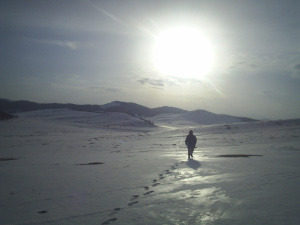
Karen Demavivas: Walking in Mongolian Steppes
While grappling with this research on Southeast Asia, I was already working in a different field at UNESCO Headquarters focused on Central Asia. It was a role grounded in another area of my research on how nomadic tents during the era of Genghis Khan’s campaigns informed sedentary architecture in what is now Afghanistan. In both regions, I also had a driving interest in how the politics of cultural heritage related to community development: in Thailand with ethnic communities from the Northern region and Burma; and in Afghanistan with the ethnic Hazaras (of Mongolian descent) who were historically repressed by the dominant Pashtun tribes in the region. Yes, I know, it’s a head spin for me, too.
These dynamic moments of exchange inform a fluid cycle: as I move forward and engage with new faces and experiences, the more and more I am reminded of people, sites, and contexts from my past.
What would be another name besides “culture worker” for your role in the field?
“Accidental ethnographer” comes to mind: a way of informally entering and exiting communities and places without ever fully saying goodbye. It is “accidental” in that I was never formally trained as an expert in these observations and engagements with culture and community. Rather, my “field work” developed organically, grounded in the reality of the day-to-day, chance (or fate), the recognition of windows of opportunity and reciprocity, and acting upon them. I would fluidly and respectfully learn, adapt, and contribute to specific relationships, projects and places. Then I would slip away without much ceremony, but still maintain a kind of continuity, an opening to return…
I once lived for a time with a herder community in the steppes of Mongolia. I would help set up the ger (a permeable felt-covered trellis tent), ride horses, herd the sheep and goats on the hillside, milk cows, and welcome visitors. They would often come unannounced. We would serve them buttermilk tea with milk straight from the cow that morning, some dried mutton from animals slaughtered in winter, and steamed dumplings. There would be some talk of horse thieves, the changing weather, the state of grazing, the health of the herds – and perhaps some throat songs. Then the visitors would get up and head for the tent opening without so much as an adieu. They would simply mount their horses and ride off without a glance – until next time – to venture out into the wide, open space of the sublime.
Karen Demavivas is an internationalist, culture worker, and change-maker who resides in Brooklyn when she is not living abroad. She served as Program Officer of the Immigrant Artist Project at the New York Foundation for the Arts. Prior to that, Karen was a two-time Fulbright Fellow, which led to specialist roles in culture and development at UNESCO and the UN Population Fund, NY. Her art and culture writing has been featured in the Brooklyn Rail, the Bangkok Post, and Art4D Magazine, among others. She is currently based in Rio de Janeiro, Brazil.
Cultural Fluency: Engagements with Contemporary Brooklyn
Presented by BRIC Arts | Media | Bklyn, the exhibition Cultural Fluency: Engagements with Contemporary Brooklyn takes place March 14 – April 27, 2013 at BRIC Rotunda Gallery in Brooklyn, NY. Below is the curator’s essay to the exhibition’s newspaper/catalogue:
____________________________________________________________________________________________
“For the artist, obtaining cultural fluency is a dialectical process which, simply put, consists of attempting to affect the culture while he is simultaneously learning from (and seeking acceptance of) the same culture which is affecting him.”
– Joseph Kosuth, “The Artist as Anthropologist,” 1975
Cultural Fluency: Engagements with Contemporary Brooklyn brings together six artists whose active and purposeful engagements with the city embody its culture. The exhibition is part of a wider dialogue examining the creative exchange between urbanism and art practice. In the spirit of Cultural Fluency, this newspaper/exhibition catalogue includes conversations with the artists as well as with contributors from different fields.
The exhibition, ranging from public artwork and photography to “guerrilla opera bombs”, highlights artwork that depicts Brooklyn while also altering our perceptions of and experiences in the borough. The artists featured all regularly operate at the intersections of art, place, and community, often with an innate political awareness.
Working in response to the exhibition concept and the gallery space itself, David Court’s text-based work, A Description Without Place & A Glossary for Other Spaces, expands throughout the gallery walls, exhibition postcards, and this newspaper. In a playful yet strategic manner, Court draws attention to the multiple forces at work in the production of space, specifically addressing the materiality of BRIC Rotunda Gallery, the layout and experience of the exhibition, and its implication in larger frames of building and inhabitation.
From Here I Saw What Happened and I Could Not Understand (aka The Obama Skirt Project) is a year-long performance artwork by Aisha Cousins during which she vowed to wear fabrics bearing President Obama’s image every day. The fabrics were collected shortly after Obama’s election in 2008 from Nigeria, Ghana, Mali, South Africa, and Tanzania, where there is a long tradition of depicting the faces of black political leaders on clothing. She wore the Obama fabrics until her friends and neighbors began to see them (and the mind-set they represented) as normal. Cousins documented her experiences by writing a series of performance art scores. The piece expanded into the creation of a group called The Story Skirt Project, whereby participants re-perform Cousins’ work by wearing Obama fabric and documenting their own stories.
Vocal artist Malesha Jessie challenges the notion of ‘authenticity’ in opera performance being tied to a ‘legitimate’ venue and audience. Her guerrilla opera bombs in the barbershops, bodegas, stoops, and sidewalks in Bedford-Stuyvesant engage a surprised public who pause to listen and even spontaneously dance to her performances. The 8-minute video loop Guerrilla Opera is presented openly, allowing the film’s music to permeate the gallery space and alter the experience of viewing nearby artworks.
Hiroki Kobayashi’s photographs of the endangered Slave Theater, once a hub for civil rights activities in New York, uncover a history that is at risk of being buried. Abandoned for years and at the center of a bitter dispute over ownership rights and competing visions for a neighborhood landmark, the theater’s future is uncertain. By re-presenting the politicized murals inside the iconic building in a new gallery context, Kobayashi re-introduces the soul of the theater and its history to an expanded demographic, possibly affecting its future.
For over three years British artist Martin McCormack has been walking the length and breadth of New York City, gathering tattered subway maps, tourist maps, and maps found on take-out menus. An active interplay between commerce, leisure, location, and art practice, The Great New York City Mapping Project is a dynamic re-creation of the city, in graphic form.
Mark Reigelman’s Stair Squares is a response to ongoing activities on the steps of Brooklyn Borough Hall while actively altering the space. The collection of public furniture accentuates and encourages the use of the public steps as a grand civic stoop. Presented on a custom-built stoop for the exhibition, visitors are welcome to sit and linger, shifting their perspective and becoming part of the exhibition.
The exhibition is conversational and participatory not only by engaging the public in the gallery space itself, but by expanding the dialogue through its communication materials. Newspaper contributors Laurie Cumbo, Matthew Deleget, Karen Demavivas, Keith Gill, Thomas Leeser, Syreeta McFadden, and Hanne Tierney discuss the relationships between politics, community, architecture, poetry, and performance with their art and with the city.
On Thursday, April 4, 2013, Inside Cultural Fluency extends the dialogue further. The public program night features Q&As with the artists and the Bed-Stuy Story Skirters (a group of Brooklyn women who have been re-performing Aisha Cousins’ The Obama Skirt Project), as well as interactive performance art scores directed by Cousins.
The public is invited to visit and participate in the online forum culturalfluency. info, whereby Cultural Fluency will continue to grow beyond the confines of a gallery exhibition. By regularly including new interviews and conversations across fields and globally, the blog will continue to examine the creative exchange between the city and art practice. At the risk of being utopian, it is my hope Cultural Fluency will help our understanding of the human condition in our city and in our society – essentially shaping our ‘place’.
– Erin Gleason, Exhibition Curator
Erin Gleason is an artist, curator, and designer based in Brooklyn. She studied Fine Art, Imaging Science, and Anthropology at the University of Pennsylvania, and received her MFA in the Art/Space/Nature Program at Edinburgh College of Art, University of Edinburgh, Scotland. Gleason has exhibited and curated in the U.S. and internationally and has created works for a variety of public sites. She is the co-founder/director of the Crown Heights Film Festival, co-editor and designer of the publication FIELDWORK (ASN Mutual Press), recipient of a Russell Trust Award for research in Greenland, and a 2013 Lori Ledis Emerging Curator Fellow at BRIC Rotunda Gallery in Brooklyn, NY.
