Tagged: BRIC
Malesha Jessie
What made you interested in challenging the traditional trajectory or parameters of an opera singer?
So many things made me want to challenge the traditional idea of the ‘opera singer.’ Firstly, I know that I don’t look like a typical opera singer, and just about every person I meet reminds me of that fact, actually. I knew I had this talent, and I knew it wasn’t typical. Instead of letting that hold me back, I took a step forward and decided to embrace my non-traditional look and my natural hair and boldly share my gift with those who lived closest to me. It’s so strange how we opera singers can travel all over the world, wear costumes and wigs, and sing in several different languages, and the very people closest to us may never hear us sing because they didn’t buy a ticket to our performance. So many of my friends, relatives, and neighbors could know me for years and still not have heard me sing, let alone know I sing opera. I thought it was time to share my gift and abandon tradition. Tradition can hold us back. While there is still great need for the wealthy patron, opera has got to expand and be what it always was: musical storytelling. And anyone, regardless of their economic situation, can appreciate a good story and they deserve to be at the “dinner table.” I am concerned for opera’s role in society today. It has always been an elite art form, but it’s going to need to expand its doors to the whole community.
How did performing in non-traditional places inform your work as a vocal artist? Are you continuing this type of practice outside of Brooklyn?
This venture into non-traditional performance and venue has caused me to be able to embrace my whole self, the same “self” that has to act a character. I am more comfortable with who I am, and it is expressed in my voice and my body. It is in fact, me that people pay money to hear. No one wants to watch a phony on stage.
This boldness helped me to launch Opera Open-Stage nights. I took what I loved about the open-mic scene in Slam Poetry and decided to incorporate that communal and supportive spirit in the opera field. Opera singers need an underground scene to keep us inspired too. I plan to start Opera Open-Stage nights in Southern California.
Any memorable encounters while filming “Guerrilla Opera” in Bed-Stuy?
I loved singing in the bodega and being mocked by a customer who also called me “cute.” I am often mocked by folks, including family and friends. It’s funny how opera can be a joke to so many people and at the same time, be profoundly beautiful. The juxtaposition of humor and serious music-making is in all of these videos.
What prompted you to start MuseSalon Collaborative (a socially conscious network that supports artists and arts organizations), and how does it affect you, as a performer and artist?
MuseSalon came from a burning desire to connect artists with one another. Artists are powerful and vital to society and we need each other in order to manifest our talents and visions and color the world. I came to realize this profoundly when living in New York, the artist’s Mecca. My artistic identity is fueled by my awareness of my community, and I want to be an active member of the community. I cannot merely make art and ignore those closest to me, both fellow artists and neighbors.
Malesha Jessie is a versatile artist of both the operatic and concert stages. She received her Masters of Music degree from the University of Southern California, Los Angeles, and her Bachelor of Music degree from California State University, Fullerton. Jessie has sung throughout Europe and the United States, including performances with the Boston Pops Orchestra, American Symphony Orchestra, and the San Francisco and Los Angeles Operas. She is the founder of Muse Salon Collaborative, a social enterprise that fosters cross-disciplinary dialogue and collaboration through an international arts network. Jessie recently relocated from Brooklyn to San Diego, CA.
Thomas Leeser
When designing cultural institutions and museums, what is your approach to the building’s relationship to its community and the city at-large?
Architecture is itself a form of cultural production and as such one of the first things to consider is its impact on the community, on the institution itself and its contribution to the city at large. Architecture plays a key role in the way we feel about our cities, neighborhoods and the environment we live in. It is therefore very important to realize that architecture is in many ways one of the most powerful voices an institution like a museum may have. This puts the architect into a position of extreme responsibility far beyond the mere functionality of a building.
Since the recession, have you seen a shift in attitudes for design that reflect an arts organization’s relationship to the city, including issues such as politics, race, and gentrification?
All I know is that when we started with the Museum of the Moving Image in Astoria, Queens, it was a very different neighborhood. Many things changed over the years, and after we opened the museum in 2011, it had become apparent even to people who initially felt that the architecture wouldn’t matter that much in a neighborhood with very little foot traffic, that it was quite the contrary. Architecture mattered in a real big way. It suddenly helped shape a new identity for the neighborhood. People who you wouldn’t expect to pay attention to Astoria suddenly talked about it as if it was a new institution on the Upper East Side. It was really interesting how people who would never go to this part of the city suddenly knew about it. At the same time, it was really satisfying to see how people who had lived in the neighborhood for a long time suddenly developed a new sense of pride. This was really one of the greatest moments for me as an architect – to see how architecture actually affected peoples lives in such a positive way. It was a confirmation of what I believe is our biggest task as architects in our society. And I think a similar thing is happening with BRIC House. All of a sudden, BRIC House has a face that one can see, a locus that one can recognize and orient oneself on within parts of Brooklyn. All of a sudden you can feel and see the institution that was literally invisible before.
Your design for BRIC House (which will for the first time bring the organization’s contemporary art, performing art, and community media programs under the same roof), incorporates a very large indoor stoop. Are there other architectural gestures that encourage interaction and exchange between artists and the public, or that ties the building’s activities to Brooklyn culture?
The large stoop is of course central to the design, the institution, but it’s also meant to be symbolically central to the neighborhood. Brooklyn is a multi-cultural city unlike any other, and BRIC House is located precisely at Brooklyn’s cultural center. As such, it seemed appropriate to provide a non-formal place for social interaction precisely between the theater, the TV studio, the gallery and the street. And it is at the street level where we made a small but significant gesture by pushing the street front into the facade as to allow a visual and physical connection with passersby to the symbolic center of BRIC House.
Architecture can have a profound affect on a community. How does engaging with that community and ‘place’ affect you, as an architect?
It is the very reason to be an architect. To affect the community and our environment, which means to change it. Change – in the sense to enable one to understand one’s environment and world around us in a new way – allows us to see things in a different light and to open one’s experience and the way we feel about things. This is what we can only hope to achieve when we design for our community, and this is what affects us as architects in return.
Has your vision and design approach as an architect changed by working with many artists, performers, and arts organizations over the years?
I started as an artist, which I feel is a very uncomfortable description of one’s activities. Maybe this is why I decided to become an architect, and yes, working with artists is always influencing the way I think about things. This is what artists need to do, and this is what I want to be inspired by.
Being based in DUMBO and in a building that includes artist studios, non-profit organizations, and an incubator for media start-ups, is cross-arts collaboration or dialogue something you seek out? Or is it a natural part of your life and work?
It is of course both, but being in an arts community like DUMBO, a lot happens by osmosis. Just walking down the street and seeing many ideas leaking out of the many workshops, galleries or the theater across the street is daily inspiration for me.
Thomas Leeser studied architecture at the University of Darmstadt, Germany and at The Cooper Union, NY under John Hejduk, Peter Eisenman, Raimund Abraham and Bernard Tschumi. He has taught at such institutions as Princeton, Columbia, and Harvard universities, and he is currently a professor at Pratt Institute. Leeser Architecture has won many international awards, including most recently the prestigious Red Dot Award for the design of the Museum of the Moving Image in Queens. Current large scale projects are under construction in Abu Dhabi, Bangkok and New York.
Martin McCormack
How did The Great New York City Mapping Project begin?
Very often people will come up to me in the street and say, “Martin, how is it you started your map project anyway?”
“Well,” I reply, “let me bring you back to that chilly day in November when it all started.” I straighten out an old half-finished cigarette, which I produce from my shirt pocket, and light it. Pulling deeply on the smoke, I begin: “You see,” I say, “I was walking through Bedford-Stuyvesant with my girlfriend and our mutual friend Chela Edmunds, when I saw an old restaurant menu lying on the ground. Now, rubbish on the ground is no rare thing, but this piece of rubbish had a little map, which intrigued me at the time. The map helped illustrate the exact location of the restaurant by showing a few blocks, the names of a couple of streets, and an arrow, as I’m sure you’re familiar with. Following a habit I had observed in my father, I put the piece of rubbish in my pocket.”
“The story, such as it is, might have ended right there at the pocketing of the menu, had I not found a second menu a little further along the road. This menu was from a different restaurant than the first. This menu also had a map, but it showed a slightly different area of town than the first, illustrating its different location. I found to my delight that when I put the two maps together they made a larger, contiguous area. I surmised, foolhardily, that if one were to walk the whole length and breadth of New York City, one may very well gather enough such maps to build a complete map of this vast metropolis.”
So The Great Map Project was born, and I have talked about little else since to the detriment of friends and strangers alike.
You must have walked countless miles, meeting a lot of people along the way.
I’ve no idea how many miles I’ve walked over the last three years to collect all the hundreds of maps that make up the collage, and the hundreds more I didn’t use for one reason or another. All of my routes are written down in the form of lists of addresses. I could enter them all into some kind of “Google maps thing”, and maybe it will tell me all the miles I’ve walked. It feels like more than 100 but less than 10,000 – somewhere in that range. I wish I had worn a pedometer. I hardly ever meet anybody, only when I’m in a good mood in a nice neighborhood, and not hungry or needing to pee or feeling shy and awkward, which is rare enough. I prefer to lurk, at first startling then bemusing the locals.
Have the conversations you have had with people you met along the way influenced your work?
I try to keep a written record of my experiences exploring the different neighborhoods. In this respect, the conversations I’ve had with people while collecting the maps have influenced the work. My natural inclination is to write about a neighborhood, like some kind of embittered but semi-literate P.J. O’Rourke. But after talking with people and getting to know a place a little better, this impulse is usually tempered. People are often good hearted and well meaning, or at least benign, and it’s not really their fault that they live in an ugly, disspiriting subdivision that is ill-conceived, unimaginative, and blighted through generations of social mismanagement. In the beginning of this project, I focused on the buildings and infrastructure. But a neighborhood is more about the people, and I’ve made an effort more recently to show that.
Do you feel like NYC is more of your home since you started this project, or does it make you feel more like an outsider?
I’ve always felt like a bit of an outsider wherever I’ve lived, and although it’s a cliché to say it, New York City is a very accepting place where you can be or do anything you like – provided you’re not bad at it. If you’re bad at it then this city is brutal. If I feel more at home here, it’s not through any new understanding of the city. Doing the mapping project, and exercises like this, has rather helped me understand myself and my place in the city. This is the first time that I’ve had to think about myself in terms of geography, so I suppose that’s a “yes.” This project has helped me feel more at home here.
A memorable encounter?
As I trudged along the still snow-covered sidewalk of Astoria Blvd., the temperature quite perceptively began to plunge. The filthy puddles of melted snow began to skin over with ice. The wind took my breath away, and I zipped my hood up like Kenny McCormack to keep out the cold. I could hardly hold my list of addresses for the cold, but a noble voice from within urged me forward. Would mere cold keep me from mapping Queens entire by the year’s end? Nonsense! Forward!
A seemingly senseless quirk of my route-planning process is that I rarely know en-route where it is I am going or what it is I am looking for. I found myself still walking down Astoria Blvd. long after the commercial and residential aspects of the road had abruptly ended and the four-lane highway began. As the cars and trucks blasted past me, I bleakly beheld what surely was my intended destination. On the right lay a snowy, forsaken graveyard, penned in between highways and with no entrance in sight. Cursing the day I was born, I skirted the fence until I found an entrance several hundred yards further along. Past rubble and building sites, past gravestones of dead Germans and Italians, the wind still bitterly blowing and the temperature dropping further, I walked towards a flagpole sensing that graveyard attendants gather under the colors of the US flag. I was right and I collected my prize – a map of St Michael’s cemetery. Beautiful, but unfortunately too big to use.
After pissing and uttering some gibberish to the kind ladies in the office, I took my leave whereupon, almost immediately, I got lost among the winding paths and German and Italian gravestones. I was about to turn back to the kind ladies when I met with the most extraordinary vision. Standing right there in front of me, blocking my way, was the most enormous white cockerel sporting a quite blood-red head. I stopped dead in my tracks. Astonished beyond all telling, I attempted to ascertain the amount of danger I may be in. The cockerel moved not one inch during this time except for his beady yellow eye, so I decided somewhat reluctantly that I could pass the creature without incident. Possessed now with calm sobriety, I saw that the creature was not as enormous as I had feared, but merely standing there in the tundra with its feathers puffed up for warmth. Why it should pick such a bleak and windy spot was beyond my reckoning, and as I was eager to leave such a place, beyond my patience. I took the vision of the cockerel with the blood-red head as some kind of portent, and decided to forego the rest of my damned list of addresses and make directly for home. And with my hackles raised I did just that.
Some time has passed since my meeting with the cock, and my thoughts do turn to it from time to time. Could it be that a cockerel lives wild here in New York, albeit not in a very fashionable part of the city? Or was the creature a figment of my imagination, brought on by the intense cold? Was its presence for good or for evil, or was it a neutral force existing for its own benefit and amusing itself by lurking eerily to frighten passersby? I suspect a simple phone call to those very nice ladies who so kindly helped me with the map would clear up most of these questions, but in God’s name, what would the fun be in that?
Originally from Liverpool, England, Martin McCormack is a Brooklyn-based artist who graduated with a Bachelor of Arts from the University of Ulster in Belfast, Northern Ireland. He has produced “exhibitions” on various trees, walls, and embankments throughout New York City and in Colorado, in addition to exhibiting in a number of galleries including Leo Kesting Gallery, NY, and Five Myles Gallery,
Syreeta McFadden
What is the relationship between language, art, politics, and ‘place’ in your work?
I guess the best way to describe that relationship is integrated. Integral? I’m still trying to figure that one out. I don’t think I separate language of written word from visual representation. Both have a language and are in dialogue with one another. I think story is the key undercurrent to my work. I’m deeply interested in overlapping narratives that exist in communities, which is reflected in my use of overlapping forms in prose, poetry, and photography. The identity of place is a big part of my process, and is informed by my previous professional experience in urban planning and community development. In that work, the narratives that place or places carry were key to understanding the language, the collected memories of communities throughout the city. You cannot transform a neighborhood into your image, ignorant of the legacy a building or park carries with it in the imagination of the long-time residents of a community. And certainly, by extension, you can’t build or create new spaces ignorant of the social fabric and identity the community has embraced after years of change. Perhaps that’s where politics enters? Maybe.
Are publications and various media outlets part of your art form? How do these outlets differ from performance?
I’m one of the co-founders and editors of an online literary journal called Union Station. It’s strictly an online medium – no accompanying printed matter as of yet. When we created Union Station two years ago we were responding to a void that occurred in the literary world, a journal that presents a pluralist representation of writers in America. We wanted a forum to engage these narratives. Union Station is premised on the idea that every city (town) in America (and globally) has a Union Station, a main hub of activity and interconnectedness that by the happenstance of place, whole worlds of people connect and collide, and like a Venn diagram, in that overlap comes the story, the poem, the photograph…
I think the digital world can be performative too. We’re seeing a great deal of innovation and some back to the future elements (the GIF is dead! long live the GIF!). In the absence of live performance, we’re able to connect to a wider audience through internets, to capture or isolate moments in performance. I’m hoping to refine that idea some and play with the form of digital storytelling.
Live performance lends itself a different lens of discovery that’s so immediate between you and the audience. I don’t do enough of it. Last summer at a performance I did at The Kitchen to a majority Croatian-New Yorker audience, I really got the sense and feel of that wall break in an intensely shared moment of collective memory about American identity and otherness.
How important is community engagement in your work and how does it influence your art? What type of engagement or cultural exchange with the city itself do you practice?
I think community engagement with some of my projects is extremely important. I’m a photographer and co-curator of a public art experiment called PUP (Poets in Unexpected Places), where a group of poets, about 8 to 12 of us, go out on subway cars, the Staten Island Ferry, a laundromat, a public park and perform poetry in kind of a spontaneous/flash mob way. Poets literally pop-up and offer poems to an unsuspecting public, and in the words of Laurie Anderson, “snap them out of their art trances.” The surprise is that we find that people are often charmed, hungry, and eager to hear more poems. We’ve had poets of various ages, gender, and ethnicities appear with us over the past three years. We encourage interaction with the audience. There’s no false wall that sanctioned performance space mandates.
Additionally, a chunk of my work is collaborative, so I rely on my artistic community to act as collaborators, even ‘actors’ in the new photo work I’m developing as part of a newer project.
Any funny or interesting stories about a project?
As we were crossing the Manhattan Bridge on the Q train, during one of our PUP appearances, a group of women were so taken in and moved by the experience, that one of them jumped up and began singing and dancing. She was dressed traditionally, in a sari and didn’t speak English. The beautiful moment of discovery and connection is that it didn’t matter the language she spoke, but her heart connected to the words offered on the train in that moment. The largest lesson is that people connect in a language across culture and community in the lovely urban coincidence riding on the Q Train to disparate locations.
Can you describe the reciprocity in storytelling between you, your work, and the city?
I’m a creature of the city. Asphalt and blood. It’s a symbiotic relationship. It’s the source of a great deal of creative inspiration for me and probably the real driving force behind my earlier career in community development. Cities demand intersectional narratives to be fully realized in art. New York is the city where Basquiat agitated to crown black men kings, Ayn Rand found her fountainhead, and Joan Didion couldn’t stop herself from coming back. As an international city, more than any other place in America we witness the manifestation of a more perfect union (with her warts and all) by the shared common dream of living in this ridiculous crowded and expensive place because it’s in our blood. How could I not be interested in these stories and where we overlap? The typography of the city is so necessary to showing the world how and why we connect. I think the biggest takeaway for me in developing these stories written or visual is engagement. The city works as metaphor and talisman in the prose, and as witness in the photographs.
Syreeta McFadden is one of the founding editors of the online literary journal, Union Station. A former urban planner and housing development specialist, she holds degrees from Columbia University in the City of New York and Sarah Lawrence College, NY. Her writing has appeared in the The New York Times, Feministing, The Huffington Post, Salon and others. She has been a featured reader at various New York area readings series and her photographic work has been featured in local galleries and online. McFadden is an adjunct professor of English and Literature and is currently working on collections of short stories and essays.
Mark Reigelman
Why public art?
Every artist has a set of personal goals, interests, and needs that need to be satisfied. I want to have conversations with a greater audience, work on a large scale, research and experience new people and places, explore a variety of concepts and materials, and offer something unique to break up the monotony of everyday life. While studio work allows me to address some of these criteria specifically, public art is the only art form I have experienced that can address them as a whole. One particular interest that public art satisfies is my appreciation of community. Community is incredibly important to me personally, and thus a vital characteristic to my public works. This notion was reinforced early in my career by the book Bowling Alone by Robert Putnam, which highlights the ramifications of social interaction. My work discusses a variety of topics from westward expansion to overprotection, but is always founded by the importance of community. Public art, especially site-specific works, allows me to become intimate with a particular site, environment, and neighborhood members. Public art not only requires an artist but more importantly, a team of dedicated people that appreciate and celebrate artistic intervention in public space.
Your humor and personality is often seen in your work. How does interacting with the public influence this personality, and on future or current projects?
My work is really a direct reflection of my interests, humor and personality. In fact, I think a small portion of my soul is imbued in each work I create. I regularly recall the experiences of main character Basil Hallward in Oscar Wilde’s book The Picture of Dorian Gray, as he discusses his inability to exhibit his work. “I know you will laugh at me,” he replied, “but I really can’t exhibit it. I have put too much of myself into it.”
For me, public art is a constant conversation and not a statement. Each project I create offers a specific and unique experience and is thoroughly documented and analyzed. If there was a particular interaction that was intriguing in one I will explore it in new ways in future projects.
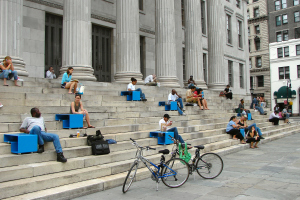
Mark Reigelman: Stair Squares, 2008
What are the beginnings of the Stair Squares?
The original Stair Square proposal used the Metropolitan Museum of Art as the installation site. Unfortunately, months of emails and phone calls got me virtually nowhere. During this initial phase of the project I was still located in Cleveland, and at this same time period Christo and Jeanne Claude were lecturing at Severance Hall. I remember the presentation like it was yesterday: I was sitting in the balcony on the edge of my seat listening to the craziest and most inspiring lecture of my life. Afterwards, I approached Christo and Jeanne Claude, interrupting their socializing in the process, to talk to them about my project. Jeanne Claude listened to every sputtered word and looked at all the images I offered. She then wrote their fax number on a sheet a paper, and told me to fax her over the details the following week when they returned to New York. I did as she commanded, and within hours of my fax she replied with contact info for several curators at the Met and informed me that she already spoke with them about my project. In a matter if days, I was having serious discussions with the Met about the project. And while the Stair Square project was never installed on the famous Met steps (due to liability issues) this chance encounter with Christo and Jeanne Claude began the chain of events that led to the installation at Brooklyn Borough Hall. Their sincerity and generosity will never be forgotten.
Where are the Stair Squares now?
Since the Stair Squares were designed and fabricated specifically for the steps of Brooklyn Borough Hall, there weren’t many options for their afterlife. So, after the installation all 12 went into storage in Downtown Brooklyn. They stayed there untouched for about five years. Then two were sent to a collector in Cleveland and one was sent to a collector in NYC. Sadly, the rest were taken to a metal recycling company in Brooklyn and turned into structural beams. Unfortunately the pieces in Cleveland have been discarded so the piece on display is the sole survivor from the original installation at Brooklyn Borough Hall.
How do you respond to the inherent temporariness, the politics of opinion, and bureaucracy of place that’s involved in public art?
I am not sure there is inherent temporariness in public art (at least not in the particular area of public art that I am engaged). In fact, most public art is designed to last a minimum of 25 years before any maintenance is needed. So, I would argue that the temporariness of public art is purely the impact and conversation it has with the individuals in the immediate community. Most permanent pieces end up becoming as overlooked as the surrounding architecture. I think it’s important for cities to have a balance of permanent and temporary pieces to ensure the public is constantly being challenged and engaged. I believe Public Art is about having a conversation and not making a statement. There is an excellent reading that pertains this this topic – One Place After Another: Site Specificity and Locational Identity by Miwon Kwon. It doesn’t talk particularly about temporariness, but it does discuss the importance for artists to consider the specific environment permanent works are placed in, to ensure that the conversation with the local community is valuable and important. This article is also an excellent transition to the political facet of public art. The public art process is saturated with bureaucracy, public opinion, city policies, and assortment of logistical constraints. But I embrace it all! At times it’s aggravating and painful – it’s a constant push and pull – but the challenge is what makes the work exciting. At the end of those months and years of diligent work and persistence, the project is realized and there is no greater feeling in the world (Except for space travel, I can assume that space travel is probably better).
Mark A. Reigelman II is a Brooklyn-based artist specializing in site-specific product design, installations, and public art. He earned his Bachelor of Fine Arts in Sculpture from the Cleveland Institute of Art, OH, and an Advanced Product Design Certificate from the Central St. Martin’s College of Art and Design, UK. Reigelman’s work has been exhibited in public spaces, galleries, and museums across the country including the Cleveland Museum of Art, Port Authority Bus Terminal, NY, and Brooklyn Borough Hall.
Hiroki Kobayashi
As a Japanese photographer who has lived in Crown Heights for six years, do you feel like you are a part of the community, or an outsider, or both? Has making your neighborhood your subject matter affected this perspective?
I definitely feel like I am a part of the community now. The neighbors who have lived their whole lives in this neighborhood are very welcoming and are open to me being here. Through working on projects, I met a lot of neighbors and we have became friends
I often feel like I am living in a small village in New York, which I never imagined to happen. I think it’s such a wonderful thing to experience, and I appreciate it very much. At the same time, of course, I can’t be a native in this community because I come from a different culture. I think it gives me a unique point of view and position.
Why The Slave Theater?
Since I moved into this community I noticed that it’s changing very quickly. The gentrification naturally became a main interest and is reflected in my projects. I think the history and current story of The Slave Theater tells a lot about this neighborhood very clearly and symbolically. I was really surprised that it exists, and at the same time, not too many people care about the fortune of this incredibly beautiful building and its cultural heritage.
The first time I visited The Slave Theater, I met Hardy Clarence, who was a caretaker of the building. He was so passionate in sharing stories about the theater and its founder, Judge Phillips. He dreamed about reopening the theater again someday, and keeping it in the hands of this community. Unfortunately, the theater totally closed in February 2012, and Hardy Clarence isn’t there anymore.
Has immersing yourself in the neighborhoods you are working with affected your approach to photography? Is this something you will continue when you move back to Japan?
Photography is an important tool to understand subjects for me. The simple reason I started these projects in Brooklyn is because I am here. I will continue shooting wherever I will be in the future. I always find the similarities between human beings and places in different locations. I believe those similarities are the important things. I try to reveal the truth which exists in them, and share it through my photography.
Hiroki Kobayashi is a Brooklyn-based photographer originally from Hiroshima, Japan. He earned a Bachelor of Arts in Economics from Kokugakuin University, Tokyo. Kobayashi has produced varied bodies of work focusing on people and places in Brooklyn. He has had recent solo exhibitions of his images at FiveMyles Gallery and the Museum of Contemporary African Diasporan Arts; and a group exhibition at Skylight Gallery, Brooklyn.
Cultural Fluency: Engagements with Contemporary Brooklyn
Presented by BRIC Arts | Media | Bklyn, the exhibition Cultural Fluency: Engagements with Contemporary Brooklyn takes place March 14 – April 27, 2013 at BRIC Rotunda Gallery in Brooklyn, NY. Below is the curator’s essay to the exhibition’s newspaper/catalogue:
____________________________________________________________________________________________
“For the artist, obtaining cultural fluency is a dialectical process which, simply put, consists of attempting to affect the culture while he is simultaneously learning from (and seeking acceptance of) the same culture which is affecting him.”
– Joseph Kosuth, “The Artist as Anthropologist,” 1975
Cultural Fluency: Engagements with Contemporary Brooklyn brings together six artists whose active and purposeful engagements with the city embody its culture. The exhibition is part of a wider dialogue examining the creative exchange between urbanism and art practice. In the spirit of Cultural Fluency, this newspaper/exhibition catalogue includes conversations with the artists as well as with contributors from different fields.
The exhibition, ranging from public artwork and photography to “guerrilla opera bombs”, highlights artwork that depicts Brooklyn while also altering our perceptions of and experiences in the borough. The artists featured all regularly operate at the intersections of art, place, and community, often with an innate political awareness.
Working in response to the exhibition concept and the gallery space itself, David Court’s text-based work, A Description Without Place & A Glossary for Other Spaces, expands throughout the gallery walls, exhibition postcards, and this newspaper. In a playful yet strategic manner, Court draws attention to the multiple forces at work in the production of space, specifically addressing the materiality of BRIC Rotunda Gallery, the layout and experience of the exhibition, and its implication in larger frames of building and inhabitation.
From Here I Saw What Happened and I Could Not Understand (aka The Obama Skirt Project) is a year-long performance artwork by Aisha Cousins during which she vowed to wear fabrics bearing President Obama’s image every day. The fabrics were collected shortly after Obama’s election in 2008 from Nigeria, Ghana, Mali, South Africa, and Tanzania, where there is a long tradition of depicting the faces of black political leaders on clothing. She wore the Obama fabrics until her friends and neighbors began to see them (and the mind-set they represented) as normal. Cousins documented her experiences by writing a series of performance art scores. The piece expanded into the creation of a group called The Story Skirt Project, whereby participants re-perform Cousins’ work by wearing Obama fabric and documenting their own stories.
Vocal artist Malesha Jessie challenges the notion of ‘authenticity’ in opera performance being tied to a ‘legitimate’ venue and audience. Her guerrilla opera bombs in the barbershops, bodegas, stoops, and sidewalks in Bedford-Stuyvesant engage a surprised public who pause to listen and even spontaneously dance to her performances. The 8-minute video loop Guerrilla Opera is presented openly, allowing the film’s music to permeate the gallery space and alter the experience of viewing nearby artworks.
Hiroki Kobayashi’s photographs of the endangered Slave Theater, once a hub for civil rights activities in New York, uncover a history that is at risk of being buried. Abandoned for years and at the center of a bitter dispute over ownership rights and competing visions for a neighborhood landmark, the theater’s future is uncertain. By re-presenting the politicized murals inside the iconic building in a new gallery context, Kobayashi re-introduces the soul of the theater and its history to an expanded demographic, possibly affecting its future.
For over three years British artist Martin McCormack has been walking the length and breadth of New York City, gathering tattered subway maps, tourist maps, and maps found on take-out menus. An active interplay between commerce, leisure, location, and art practice, The Great New York City Mapping Project is a dynamic re-creation of the city, in graphic form.
Mark Reigelman’s Stair Squares is a response to ongoing activities on the steps of Brooklyn Borough Hall while actively altering the space. The collection of public furniture accentuates and encourages the use of the public steps as a grand civic stoop. Presented on a custom-built stoop for the exhibition, visitors are welcome to sit and linger, shifting their perspective and becoming part of the exhibition.
The exhibition is conversational and participatory not only by engaging the public in the gallery space itself, but by expanding the dialogue through its communication materials. Newspaper contributors Laurie Cumbo, Matthew Deleget, Karen Demavivas, Keith Gill, Thomas Leeser, Syreeta McFadden, and Hanne Tierney discuss the relationships between politics, community, architecture, poetry, and performance with their art and with the city.
On Thursday, April 4, 2013, Inside Cultural Fluency extends the dialogue further. The public program night features Q&As with the artists and the Bed-Stuy Story Skirters (a group of Brooklyn women who have been re-performing Aisha Cousins’ The Obama Skirt Project), as well as interactive performance art scores directed by Cousins.
The public is invited to visit and participate in the online forum culturalfluency. info, whereby Cultural Fluency will continue to grow beyond the confines of a gallery exhibition. By regularly including new interviews and conversations across fields and globally, the blog will continue to examine the creative exchange between the city and art practice. At the risk of being utopian, it is my hope Cultural Fluency will help our understanding of the human condition in our city and in our society – essentially shaping our ‘place’.
– Erin Gleason, Exhibition Curator
Erin Gleason is an artist, curator, and designer based in Brooklyn. She studied Fine Art, Imaging Science, and Anthropology at the University of Pennsylvania, and received her MFA in the Art/Space/Nature Program at Edinburgh College of Art, University of Edinburgh, Scotland. Gleason has exhibited and curated in the U.S. and internationally and has created works for a variety of public sites. She is the co-founder/director of the Crown Heights Film Festival, co-editor and designer of the publication FIELDWORK (ASN Mutual Press), recipient of a Russell Trust Award for research in Greenland, and a 2013 Lori Ledis Emerging Curator Fellow at BRIC Rotunda Gallery in Brooklyn, NY.
